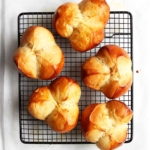
Austrian Easter Brioche Buns (Osterpinzen)
This is an easy recipe for soft and fluffy Easter Pinzen. In Austria, these soft brioche buns are very popular for Easter!
Yield: 10 small Pinzen
Ingredients
- 1 cup + 2 tablespoons (270 ml) lukewarm milk
- 2 1/4 teaspoons (7 g) instant dry yeast
- 5 1/3 tablespoons (75 g) unsalted butter, melted
- 1/4 cup + 1 tablespoon (65 g) sugar
- 1 egg (large in the US, medium in Europe)
- zest of 1 organic lemon
- 1 teaspoon (6 g) fine salt
- 500 g (about 4 cups) bread flour (also works with AP-flour)
For brushing:
- 1 egg yolk + 1 tablespoon milk
Instructions
Make the dough and 1st rise:
- You can make the dough by hand or in a stand mixer with the dough hook attachment. In a large bowl add warm milk, sprinkle instant yeast on top and let it sit for 1 minute (or 5 minutes if using active dry yeast). Meanwhile, melt butter and let cool.
- Add sugar, egg, lemon zest, melted butter, and salt to the bowl with the milk. Briefly mix everything with the dough hook or a cooking spoon. Add roughly half of the flour and stir until combined and then add the rest of the flour.
- Knead 7-10 minutes until the dough is smooth, moist, and elastic. If kneading by hand, I usually do it directly in the bowl since the dough is pretty tacky. The dough should clear the sides of the bowl towards the end of the kneading time. If not, add a bit additional flour (tablespoon by tablespoon).
- Let the dough rise, covered, at warm room temperature until doubled in size, about 1 to 1½ hours. At cool room temperature it takes a bit longer. See note if you want to do a cold, long rise. Line 2 baking sheets with parchment paper.
Shape dough into balls and 2nd rise:
- Divide the dough into 10 equal portions and shape into balls. To do so, flatten each piece on an unfloured working surface and fold the edges inwards to the center, then pinch the ends together. Turn seam-side down and roll the ball under your palm on the counter to get a smooth shape.
- Transfer balls to the prepared baking sheets. Combine egg yolk and milk for the egg-wash. Brush balls with egg-wash (keep leftovers for later). Let buns rise, uncovered, until puffy, about 30-45 minutes. You can put them in a slightly warm oven to speed up the rise.
- Preheat oven to 375°F (190°C) or if using a fan-oven to 350°F (175°C). At the end of the 2nd rise, brush buns again with egg-wash (thin with more milk if there is too little left). Let the egg-wash dry for 1-2 minutes.
Score buns and bake:
- Cut the buns 3 times from the centre to the edge with a pair of scissors (make deep cuts, see video above for reference). If you have leftover egg-wash, you can brush the cut surface too. The sections will grow back together while baking and will result in the distinctive Pinzen shape.
- Add sheets to the preheated oven and bake until the buns are risen and golden brown, about 15-20 minutes. If using a fan oven, add both sheets at once. If using an oven with top and bottom heat bake one sheet at a time or if baking both sheets at once, swap half-way through for even browning.
- Let the Pinzen cool for a bit and enjoy when still warm. The Pinzen taste best on the baking day. Store leftover buns in an airtight container (they keep a few days) and reheat in the microwave for a few seconds until warm before serving – this way they will soften. Or reheat at 300°F (150°C) for 5 minutes in the oven.
Notes
Dough with wine and anise:
Traditionally, the Osterpinzen dough contains white wine and anise. If you want to add these flavors, bring 1/2 cup (120 ml) white wine together with 1 teaspoon anise seeds to a simmer in a saucepan. Let the anise seeds steep in the wine until cool . Strain before using. If using the wine, use 1/2 cup less milk (so you need to use 150 ml =1/2 cup + 2 Tbsp) for the dough.
Long cold rise:
Right after kneading, let the dough rest at room temperature for 20 minutes, tightly covered (it will not rise during this time). Then, put in the refrigerator overnight, 10-15 hours. During this time it should double in volume. About 3/4 to 1 hour before shaping into balls, remove the dough from the fridge to bring it to room temperature.